Kyudo, the “Way of the Bow”, is the modern Martial Art of Japanese Archery.


Home > Spirit of KYUDO > Shin Zen Bi


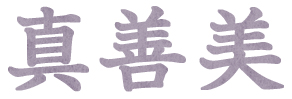
SHIN(Truth)
In Kyudo, true shooting is that of no deceit. As in the expression "straight as an arrow", if arrows naturally fly straight, one might wonder how the shooting could possibly be deceitful
Seeking the answer to this question is an essential aspect of Kyudo. The greater purpose of the act of shooting the bow is to seeking the truth. Every shot is devoted to getting closer to the truth.
The truth of the bow is measured by its sae (serenity), tsurune (sound of the string during release) and tekichu (hitting the target). The way of the bow is a process of seeking Shin by improving these skills, one shot at a time.
ZEN(Goodness)
Zen is the manifestation of the ethical aspect of Kyudo. The ethics of Kyudo such as Rei (courtesy) and Fuso (non-confrontation) requires one to always stay calm and not lose their composure. In these modern times, it is natural for one to seek sophistication, introspection, peace and equality. Kyudo does not promote strife, hostility or vengeance. The crucial idea of Kyudo is to associate, bond and be at peace with others while maintaining serenity at all times. This discipline is the basis of Kyudo. Nowadays, the decline in moral standards is often considered a current dilemma. The ethics of Kyudo could be a key to overcoming this problem.
BI(Beauty)
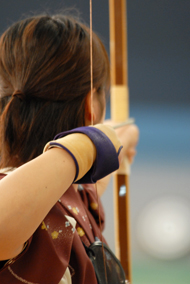

Beauty is usually appreciated as something visually pleasant. However; in Kyudo, beauty lies in Shin and Zen. The Sharei (ceremonial shooting) is one way of expressing this concept. The Japanese yumi is exquisitely beautiful in its shape, but what really stimulates the sense of beauty is the dignity, the Shintai Shusen (harmony in all movements) and the rhythmical movement created by a calm state of mind. This aspect is original to the Japanese way of the bow. The German philosopher, Eugen Herrigel said "The English long bow is drawn with the strengths of the arms from shoulder height, but since the Japanese bow is raised high and drawn downwards it is only necessary to use enough strength to open the arms apart." The beauty of Kyudo is this force-free style of shooting.
Shin Zen Bi are the three fundamental ethics of Kyudo; a guideline for present-day and future Kyudo practitioners. Kyudo is no longer just a martial art. For Kyudo to continue on for many generations, it must keep its appeal to the modern world not to be lost and forgotten.



Etiquette
It is only natural that the form of Kyudo should differ with the demands of each generation. In olden times, it was said that the Ogasawara School was highly regarded for its etiquette and that Heki School was regarded for its shooting. The Ogasawara School led in establishing the ceremonial principles of etiquette, while the Heki School led in establishing the shooting technique. While both schools were distinct in their own way; as times changed so did social conditions. Both schools pursued a way of unifying some of their differences. They came to realize that etiquette without technique cannot truly be called shooting, while technique without etiquette was not the path of Kyudo. Both technique and etiquette provide an inseparable unity to the shooting that is the truth of Kyudo.
Evidence of this combination can be seen in the gradual disappearance of the words such as Kyujitsu (Art of the bow) or Shajitsu (Art of Shooting) mid-Meiji Era with the word Kyudo (Way of the bow) becoming more commonly used.
If you are preoccupied only with the shooting technique and lose sight of manner and etiquette, then this shooting is only for sport and not only loses depth but the form becomes disorderly. However; on the other hand, if you indulge too much in etiquette and are neglectful of shooting technique, this becomes rather dead and empty shooting.
Shooting technique and etiquette should become as one. Then it can be said that, "Truth, Goodness and Beauty (Shin Zen Bi) are manifested by the 'utterance' of the shooting, which comes with lightning speed from a state of mind without wickedness."
The purpose of Japanese Kyudo is not only competition, but the cultivation of the mind and body as a way to achieve self-perfection. Throughout Japan, this understanding of Kyudo has become widely known - a fact that is truly gratifying and one that gives meaning to spread and further development of this tradition all over the world.
The Spirit of Ceremonial Shooting

Since earlier times, sharei (ceremonial shooting) has been the performance of ritualized shooting to celebrate a religious ceremony, or other formal occasions. It was based on those principles of etiquette that traditionally governed the behavior of daily life.
Traditionally, etiquette was inherent in all aspects of daily life, and this inseparability of etiquette from a situation is expressed in the saying, ''Sha wa, rei ni hajimari, rei ni owaru,'' (Shooting begins with etiquette and ends with etiquette) meaning that one should act according to the time, place and ranking of the situation.
With this awareness, the movements of the shooting will become graceful and solemn, creating a state of spirit in which there is serenity and purity of heart, which is the harmony of shooting and etiquette. The application of this sincerity to each arrow is the principle object of Kyudo.
This meaning is inherent in the classical writings of the Raiki, which says, "This shooting is the bequeathed teachings of the sage, in which the round of moving forward or backward can never be without courtesy and propriety." Another quote from an ancient source expresses it from an ethical viewpoint "In this way, everything is the disciplining of morality. This victory terrifies the whole realm, and training inner virtue, the outer enemy is terrified. This is to serve the body of the shooting." What these statements imply is that historically from generation to generation the bow has been an important tool with which to polish one's virtue and to establish the ethical and moral structure of society.
Shooting, which in this way places a strong emphasis on the spiritual, should be pervaded with sincerity and courteousness and through the shooting express your heart and the beauty of harmony.
Ceremonial shooting not only reflects traditional values, but as the ceremonial form of Kyudo is the vehicle that can give expression to the basic behavior and movement, as well as the shooting principle and technique. Accordingly, it has been the practice since olden times that ceremonial shooting is performed by an experienced archer who has mastery of these fundamentals. Keeping in mind the significance of ceremonial shooting from its historical context, one must be devoted to mastering the fundamentals of the form of Kyudo, training one's self to express grace and dignity in the shooting.