【1】Ashibumi - Footing
Method of Determining the Draw Length of the Arrow(Yazuka)

The draw length of the arrow is determined by the length of each individual’s arm.It should be measured from the centre of the throat to the tips of the fingers(This draw length of the arrow is called Yazuka).An additional 5-6 cm should be added for safety.
Method for Making the Footing(Ashibumi)

《1》Making the Footing with One Step

While looking at the target,take a half step towards the centre of the target with the left foot.Then,
close the right foot against the inside of the left foot and with one step open the footing with a fan-like action.In this method,do not look down at the feet.
《2》Making the Footing with Two Steps

While looking at the target,take a half step towards the centre of the target with the left foot.Then,look down at the feet and make a half step with the right foot in the opposite direction to complete the footing.
Ashibumi-Footing

Using your draw length(Yazuka) as the appropriate width, make the footing with an angle of 60°degrees between the feet,placing the tip of the big toes on a straight line to the centre of the target.
The upper tip of the bow(Urahazu)should be held about 10 cm above the floor and kept on a line to the centre of the body.
【2】Dozukuri - Forming the Torso
Set the fifth inner joint(Uwanaribushi)in line With the centre of the body.
Focus the gaze on the tip of the nose
Stretch the back of the knees(Hikagami)
Dozukuri-Forming the Torso
The centre of gravity should be placed in the middle of the body.Check the string position (Tsuru-Shirabe).Check the direction in which the arrow is pointing (No-Shirabe).Regulate the breathing.
Settle your spiritual energy in the abdomen(Tanden).The line of the shoulders and the hips should be place on the same plane,parallel to and above the line of the feet.
Place the lower tip of the bow(Motohazu) on the left kneecap.
【3】Yugamae - Readying the Bow
Yugamae - Readying the Bow
Facing to the front,nock on the right hand(Torikake),make the grip of the left hand(Tenouchi)and set the gaze(Monomi).
Monomi - Setting the Gaze
View the target calmly with the gaze of both eyes passing along the centre line of the nose. Focus the spirit and regulate the breathing.Up until the completion of lowering the bow(Yudaoshi),the eyes must not blink.
To make the space between the body and the bow(Yumifutokoro),stretch out and expand lightly both elbows as if embracing the trunk of a large tree.
Focus the breath and spirit into the centre of the feet,legs(Sokushin),hips,and the abdomen(Tanden).
1st Aim
Divide the target with the ridge of the nose.Sight to the centre of the target primarily with the right eye.

Tenouchi-Method for Arranging the Grip of the the Left Hand
The forefinger may either be bent or straight,but it must not be allowed to bend downwards.Do not let the middle finger separate from the belly of the thumb.Draw the root of the thumb and the root of the little finger together.
The Tenmonsuji should be kept well in contact with the left corner of the outer bamboo of the bow.The skin between the thumb and forefinger(Koko)should be rolled downwards.
【4】Uchiokoshi - Raising the Bow
Uchiokoshi - Raising the Bow
From the bow readying position(Yugamae),wuth a scooping sensation,calmly raise both fists up to the same height until they are higher than the forehead.By raising the fists to this height the shoulders are not influenced.Focus spiritual energy(Kiai)into the legs(Sokushin),hips and abdomen(Tanden).Do not put power into the chest and shoulders.
【5】Hikiwake - Drawing Apart
Feel as if the nock extends out to here,and draw the string with the elbow(not with the wrist).
Hikiwake-Drawing Apart
Take the stage of the intermediate draw(Churiki or Daisan=Oshi Dai Moku Hiki Sanbun no and draw apart evenly to the left and right until you reach the full draw(Kai).
With all the stretching power of the left arm push the bow,as if pushing just below the Metsukebushi joint.
Establish the grip of the left hand(Tenouchi) at the intermediate stage of the draw(Daisan).
2nd Aim:The aim should be set in the area of the left elbow.
Feel as though drawing the lower tip of the bow (Motohazu)with the right elbow.
Intermediate Stage of the Draw(Daisan),(Churiki)
Let the line of the shoulders be drawn towards the arrow.

The Path of the Arrow (Ya-Michi)and the Path of the String(Tsuru-Michi)

【6】Kai-The Full Draw
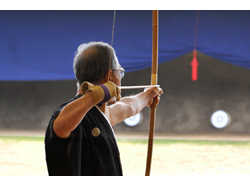
Kai - The Full Draw
Unifying mind and body,wait for the release to come.Do not hold the breath too firmly in the chest,but gradually strengthen the power of the abdomen until the optimum moment which is just before the release.
Gobu no Tsume-Firming the Five Parts
Make firm the right and left hand and both shoulders. Through expansion make the chest firm.
Hachibu no Tsume-Firming the Eight Parts
In addition to Gobu no Tsume(firming the five parts),the legs,hips and abdomen(Hara)are included in this process.
The Five Crosses(Goju-Jumonji)
- 1.Bow and arrow
- 2.Bow and grip of the left hand(Tenouchi)
- 3.Thumb of the glove(Yugake)and the string
- 4.The centre line of the chest and the connection line of the shoulders
- 5.The line of the neck and the arrow
It is important to know the working of these five arrangements.

【7】Hanare - Release
Hanare - Release
Stretch the chest open fully and the arrow will be released-Upward and downward to the left and to the right,expand the body sufficiently(Nobiai).Settle 8 to 9 tenths of your spiritual energy into the abdomen(Tanden),and at this moment ,by the driving force of the will and spirit(Kiai),the arrow will be released.
【8】Zanshin - Remaining Form(Spirit)
Zanshin - Remaining Form(Spirit)
After the release of the arrow do not change your posture but observe intensely the place where the arrow has hit. Do not lose the focus of spiritual energy(Kiai)and maintain sufficiently the expansion of this energy(Nobiai)while lowering the bow(Yudaoshi).
Zanshin demonstrates decisively the results of the shooting through the remaining form of the vertical and horizontal cross(Tateyoko-Jumoniji).
Yudaoshi - Lowering the Bow
Regulate the breathing and bring both fists down to the hips.Calmly return the gaze(Monomi).
Kyudo Glossary (Shaho-Hassetsu)
 |
Shaho- Hassetsu |
The eight step process from Ashibumi to Zanshin as part of shooting the yumi. |
 |
Hassetsu |
An eight step process |
 |
Gomi-nanad? |
A term that expresses the five spiritual aspects (Metsuke, Hikikomi, Nobiai, Hanare, Mikomi) and the seven technical aspects (Ashibumi, Dozukuri, Uchiokoshi, Hikitori, Kai, Hanare) of Shooting. |
 |
Metsuke |
Sighting the target before Uchiokoshi(Monomi) |
 |
Hikikomi |
Hikiwake |
 |
Mikomi |
Zanshin |
 |
Nobiai |
Expansions of the body during Kai |
 |
Ippon |
Literally meaning "one stick", "Hon or Pon" is a measuring word used when counting the number of arrows. |
 |
Ya |
The Japanese term for arrow |
 |
Sha |
Literally meaning "shot"; it is the moment from Dozukuri to the end result of the arrow hitting or missing the target. |
 |
Issha |
"One shot"; shooting a single arrow with the yumi |


The purpose of present day Kyudo is to enjoy and to enrich our daily life. For students, it is not only a way to train the body but an ideal way to train the mind as well. For others, it is a good way to stay fit and to acquire high spirituality at the same time. Although the way of Kyudo has changed throughout history, it has found a place in the modern world.
Kyudo is not like any other sport. The opponent is a target, not another player, and you can enjoy it by yourself. It is simple. It is accessible. It can be practiced by men or women of all ages as each individual can use a bow that is just right in size and strength. Furthermore, it is possible to practice in any weather and there is no specified rule on how long one should practice.
Basically you just aim and shoot at a stationary target. The result is judged not only by whether you hit or miss, but how the Shagyo (process of shooting) was carried out.
A good Sha (shooting) comes from good posture. You must stand with your back straight, pull your shoulders back to keep perfect balance and focus your energy on the Tanden (the lower abdomen). Then concentrate to the limit to release the arrow. If done correctly, this will lead to an accurate hit. As you wait and see that time right for you between the yumi and the target, you release the arrow calmly, accurately and boldly. Even though you might have done your best, you may still have missed the target. Take this time to reflect on what you might have done wrong. This process of reflection is a large part of our discipline and also the reason why Kyudo is so deeply appreciated by many.


As Kyudo practitioners depend solely on their senses, they are easily influenced by their surroundings or by the result of other archers and miss their aim even by the slightest disturbance. To avoid this, one must practice the fundamental movements repeatedly. It is of course important to improve hitting the target technically, but it is more important to cultivate Fudoshin (the unwavering state of mind) so that you can always conduct Gyosha accurately anywhere, at anytime and under any circumstances.
Kyudo is considered a sport in some respects. You have opponents to compete with, but not to fight against. There is victory and defeat, but competing is not the point. Any opponent must be respected. If you lose your calm by being preoccupied with the competition, you have abused the spirit of Kyudo. There must always be a clear distinction here. A practitioner who does not get carried away in competitions usually shows good sportsmanship.
As Kyudo has been increasingly recognized as a sport, it has gained wider attention and its popularity continues to grow. However, Kyudo has many other aspects that should not be overlooked. Kyudo is an ascetic practice. It is a quest for the ultimate essence of the art. In Kyudo, the competitive aspect grows through aiming and hitting the target. Along the way, there comes a point when practitioners learn that if you get too preoccupied in just hitting the target, you will most likely start to lose your calm. There is much to be learned from just the simple act of Kyusha (Shooting the yumi).